Digipath AI Test

Improve Biopsy Results with Quantitative DNA Data

Traditional biopsy analysis relies heavily on subjective morphological assessment, which creates significant challenges in achieving consistent, accurate diagnoses. Pathologists must interpret cellular changes based on visual characteristics, leading to inter-observer variability and potential diagnostic inconsistencies.

Current Limitations in Biopsy Analysis

Subjective Interpretation Issues:

Inter-observer variability: Different pathologists may interpret the same tissue sample differently

Morphological ambiguity: Early cellular changes may be subtle and difficult to distinguish

Grading inconsistencies: Subjective assessment of dysplasia severity can vary between practitioners

Limited quantitative data: Traditional methods provide primarily qualitative assessments

Diagnostic Accuracy Concerns:

False negatives: Early malignant changes may be missed during routine examination

False positives: Reactive changes may be misinterpreted as dysplastic or malignant

Borderline cases: Ambiguous findings create uncertainty in treatment planning

Prognostic limitations: Difficulty predicting lesion behavior and progression risk

Revolutionary Solution: DNA Ploidy Analysis

DNA ploidy testing transforms biopsy analysis by providing objective, quantitative measurements of cellular DNA content. This technology measures aneuploidy—the fundamental biomarker of cancer—offering unprecedented precision in diagnostic assessment.

How DNA Ploidy Enhances Biopsy Analysis

Quantitative Cellular Assessment:

Precise DNA measurement: Each cell’s DNA content is measured quantitatively

Objective data generation: Eliminates subjective interpretation through numerical analysis

Automated cell counting: Every cell is systematically evaluated and categorized

Statistical validation: Results are backed by robust analytical methods

Enhanced Diagnostic Accuracy:

98% sensitivity and 100% specificity: Unmatched accuracy in detecting abnormal cells

Early detection capability: Identifies malignant changes up to 2 years before conventional methods

Molecular-level analysis: Detects cellular abnormalities at the DNA level

Prognostic value: Provides information about lesion behavior and progression risk

The Science Behind Quantitative DNA Analysis

DNA Ploidy Measurement Process Step-by-Step Analysis:

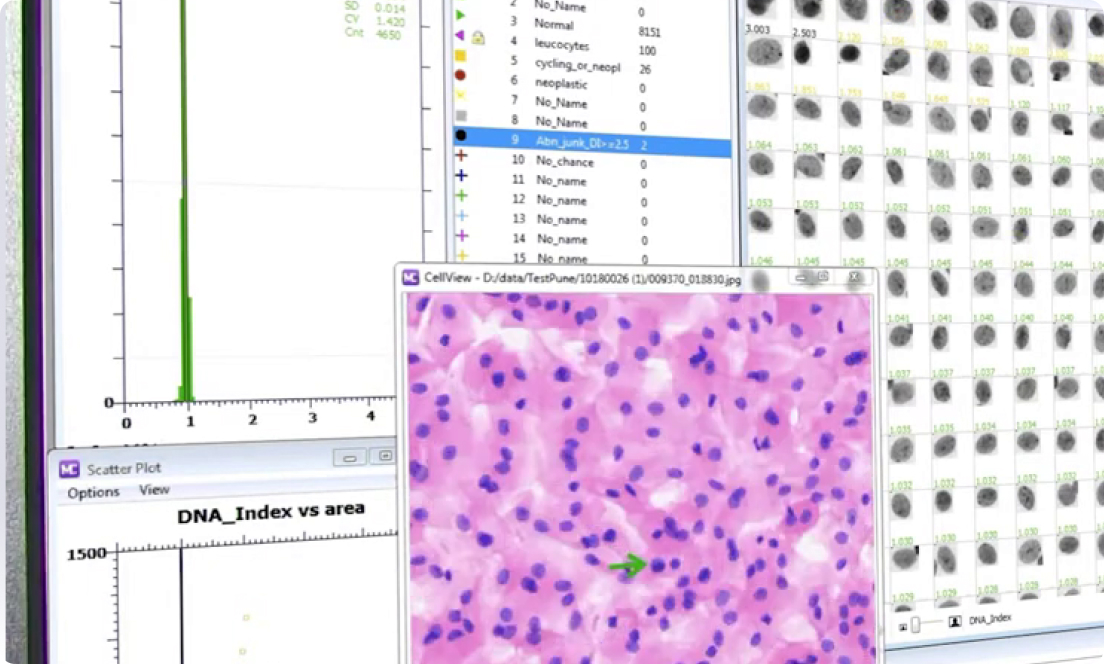
High-resolution imaging: Each cell nucleus is photographed in detail

Integrated Optical Density (IOD) calculation: Measures the amount of DNA-specific stain

DNA content quantification: Precise measurement of genetic material in each cell

DNA Index assignment: Numerical value representing cellular DNA content

Statistical analysis: Population-based assessment of cellular behavior

Understanding DNA Index Classifications

Normal Cells (DNA Index 1.0-1.25)

Diploid cells with standard chromosome complement
Stable genetic material indicating healthy cellular function
No indication of malignant transformation

Cycling Cells (DNA Index 1.25-2.5)

Cells in normal division process
Temporary state during cell cycle progression
Requires monitoring but not necessarily abnormal

Aneuploid Cells (DNA Index >2.5)

Abnormal DNA content indicating genetic instability
Strong biomarker for malignant transformation
Requires immediate clinical attention and follow-up

Clinical Applications and Benefits Enhanced Diagnostic Precision

Objective Treatment Planning:

Quantitative data integration: Complements histopathological findings with molecular information

Precise risk assessment: Numerical data enables accurate prognostic evaluation

Treatment optimization: Objective measurements guide therapeutic decisions

Margin assessment: Quantitative evaluation of surgical specimen boundaries

Improved Patient Outcomes:

Earlier intervention: Detection of malignant changes before morphological changes appear

Reduced unnecessary procedures: Accurate assessment prevents overtreatment

Enhanced survival rates: Early detection enables timely, effective treatment

Better quality of life: Precise diagnosis reduces patient anxiety and uncertainty

Comparative Analysis: Traditional vs. DNA Ploidy Enhanced Biopsy

LBC PAP TEST

Sensitivity

64-87%

Specificity

43-98%

Key Limitations

Missed ~35% of high grade lesions

HPV DNA TESTING

Sensitivity

89%

Specificity

84.6%

Key Limitations

Cannot predict cancer progression

DNA PLOIDY ANALYSIS

Sensitivity

98%

Specificity

100%

Key Limitations

Objective, quantitative results

clinical impact

Traditional Biopsy Challenges:

High inter-observer variability in interpretation

Difficulty in assessing borderline cases

Limited prognostic information

Subjective grading of dysplasia severity

DNA Ploidy Enhanced Results:

Objective, reproducible measurements

Clear numerical data for decision-making

Prognostic information about lesion behavior

Standardized assessment criteria

Case Studies: Real-World Applications

Cervical Pathology Enhancement Improved Accuracy:

Reduced false negatives: DNA ploidy detects abnormal cells missed by traditional methods

Better risk stratification: Quantitative data clarifies ambiguous cytological findings

Enhanced follow-up: Objective monitoring of treated patients

Prognostic value: Prediction of lesion progression and treatment response

Oral Pathology Applications Diagnostic Precision:

Early detection: Identification of malignant changes before morphological alterations

Surgical planning: Quantitative assessment of resection margins

Recurrence monitoring: Objective follow-up of treated sites

Treatment optimization: Data-driven therapeutic decisions

Healthcare System Benefits Direct Cost Savings:

Reduced repeat procedures: Accurate diagnosis eliminates unnecessary repeat biopsies

Optimized treatment: Appropriate therapy selection based on objective data

Improved outcomes: Early detection reduces expensive late-stage treatment costs

Resource efficiency: Streamlined diagnostic workflow reduces processing time

Long-Term Economic Impact:

Prevention of overtreatment: Accurate assessment prevents unnecessary procedures

Reduced liability: Objective results minimize diagnostic errors and legal risks

Enhanced reputation: Superior diagnostic capabilities attract more patients

Improved survival rates: Early detection translates to better patient outcomes and reduced healthcare burden

DNA ploidy analysis revolutionizes biopsy interpretation by providing objective, quantitative data that eliminates subjective interpretation and inter-observer variability. With 98% sensitivity and 100% specificity, this technology transforms traditional morphological assessment into precise, molecular-level diagnosis.
The integration of quantitative DNA analysis with traditional histopathology creates a powerful diagnostic platform that detects malignant changes up to 2 years before conventional methods, enabling earlier intervention and improved patient outcomes.
Every biopsy deserves the precision and accuracy that quantitative DNA analysis provides. This technology represents the future of pathology—where objective data drives clinical decisions and patient care reaches new levels of excellence.
Don’t rely on subjective interpretation alone. Enhance your biopsy results with quantitative DNA data for the most accurate diagnosis possible.