Digipath AI Test

Eliminate LBC PAP False Negatives

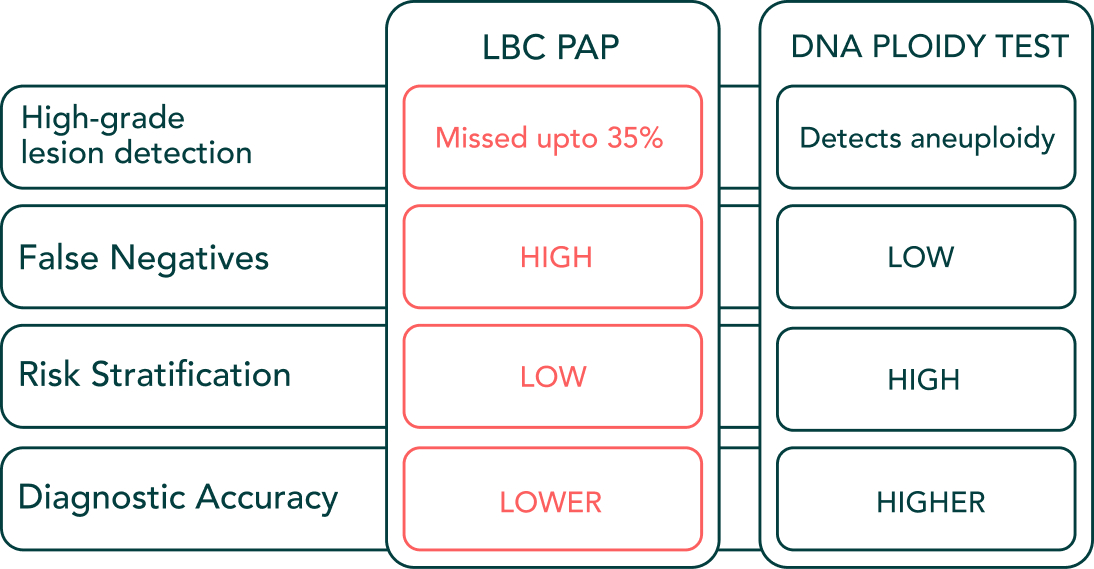
The Critical Problem: LBC PAP False Negatives Put Lives at Risk Liquid-Based Cytology (LBC) PAP testing, while an improvement over conventional PAP smears, still suffers from significant false negative rates that endanger women’s health. LBC misses approximately 35% of high-grade lesions (HSIL+), creating a dangerous gap in cervical cancer screening where potentially life-threatening conditions go undetected.

Understanding the False Negative Crisis

False negative results in LBC PAP testing occur when abnormal cells are present but not detected or correctly identified. This leads to:

Delayed diagnosis: Women with precancerous or cancerous lesions receive reassuring “normal” results

Disease progression: Undetected abnormalities continue to develop unchecked

Increased mortality: Late-stage detection dramatically reduces survival rates

Economic burden: Advanced cancer treatment costs 10 times more than early intervention

Root Causes of LBC PAP False Negatives

1. Sampling Errors Inadequate Cell Collection:

True lack of abnormal cells: Lesions located deep in the endocervical canal or submucosal areas may not be captured

Insufficient sampling: Brush collection may miss the transformation zone where most abnormalities occur

Anatomical limitations: Certain lesion locations make adequate sampling challenging

2. Screening and Interpretation Errors Human Error in Detection:

Misclassification: Abnormal slides classified as normal during screening

Sparse dyskaryotic cells: Small numbers of abnormal cells (average 13.8 cells) easily overlooked

Microbiopsies and hyperchromatic crowded groups: The most common cause of false negatives, comprising 30.5% of missed cases

3. Technical and Processing Issues Laboratory Challenges:

Pale cell dyskaryosis: Subtle abnormalities difficult to detect (4.2% of false negatives)

Distracting cells: Background elements obscuring abnormal cells (8.4% of false negatives)

Small dyskaryotic cells: Abnormal cells too small for reliable identification (6.3% of false negatives)

Low contrast: Poor slide preparation affecting visualization (7.4% of false negatives)

4. Subjective Interpretation Limitations Inter-Observer Variability:

Inconsistent reporting: Different pathologists may interpret the same slide differently

Borderline cases: Ambiguous cellular changes difficult to classify

Experience dependency: Accuracy varies with screener expertise and training

Comparative Analysis: LBC PAP vs. advance detection methods

LBC PAP TEST

Sensitivity

64-87%

Specificity

43-98%

Key Limitations

Missed ~35% of high grade lesions

HPV DNA TESTING

Sensitivity

89%

Specificity

84.6%

Key Limitations

Cannot predict cancer progression

DNA PLOIDY ANALYSIS

Sensitivity

98%

Specificity

100%

Key Limitations

Objective, quantitative results

Revolutionary Solution

DNA Ploidy Testing: Eliminating False Negatives Through Molecular Analysis

Objective, Quantitative Analysis:

Automated cell counting: Every cell is systematically evaluated and measured

Molecular-level detection: Identifies aneuploidy, the fundamental biomarker of cancer

Elimination of observer bias: Removes subjective interpretation from the diagnostic process

98% sensitivity and 100% specificity: Unmatched accuracy in detecting abnormal cells

Comprehensive Cell Analysis:

Every cell examined: Unlike LBC PAP which relies on representative sampling, DNA ploidy analyzes every collected cell

Quantitative measurements: Precise DNA content measurement eliminates ambiguity

Automated detection: AI-powered analysis identifies abnormal cells that human screeners miss

Standardized protocols: Consistent results regardless of operator experience

Enhanced Diagnostic Accuracy Through Integration Combined Approach:

LBC PAP + DNA Ploidy Synergistic Benefits:

Enhanced diagnostic accuracy: LBC PAP identifies morphological abnormalities while DNA ploidy detects aneuploidy

Improved risk stratification: DNA ploidy clarifies ambiguous LBC PAP results (ASCUS cases)

Reduced false negatives: DNA ploidy’s objective quantitative results complement LBC PAP’s subjective cytology

Better prognosis: Aneuploidy predicts lesion behavior, enabling tailored follow-up plans

Clinical Implementation Strategy Workflow Integration:

Standard LBC PAP collection: Utilize existing brush-based sampling methods

Parallel DNA ploidy analysis: Process sample through automated DNA measurement

Integrated reporting: Combine morphological and molecular findings

Enhanced decision-making: Use quantitative data to guide clinical actions

Evidence-Based Improvements Clinical Validation Results Documented Performance:

Tamil Nadu Cancer Project: DNA ploidy achieved 93% sensitivity and 99% specificity

Reduced false negatives: DNA ploidy eliminates up to 35% of cases missed by LBC PAP alone

Improved patient outcomes: Early detection enables intervention before cancer progression

Cost-effectiveness: Prevention of late-stage treatment reduces healthcare costs by 10-fold

Quality Assurance Measures Ensuring Reliable Results:

Automated validation: Built-in quality control eliminates processing errors

Standardized protocols: ISO-certified processes ensure consistent performance

Pathologist review: Expert verification of flagged abnormal cells

Continuous monitoring: Regular calibration and performance tracking

LBC PAP false negatives represent a critical gap in cervical cancer screening that puts women’s lives at risk. With 35% of high-grade lesions missed by conventional LBC PAP testing, the need for more accurate detection methods is urgent and undeniable.
DNA ploidy testing offers a revolutionary solution, providing 98% sensitivity and 100% specificity while eliminating the subjective interpretation errors that plague traditional cytology. By detecting aneuploidy—the fundamental biomarker of cancer—at the molecular level, DNA ploidy testing identifies abnormalities up to 2 years before conventional methods.
The technology exists. The evidence is overwhelming. The only question is whether healthcare systems will embrace this life-saving advancement to eliminate the false negatives that cost lives and increase healthcare costs.
Don’t let false negatives compromise patient safety. Eliminate LBC PAP false negatives with DNA ploidy testing—because every woman deserves accurate, reliable cervical cancer screening.